

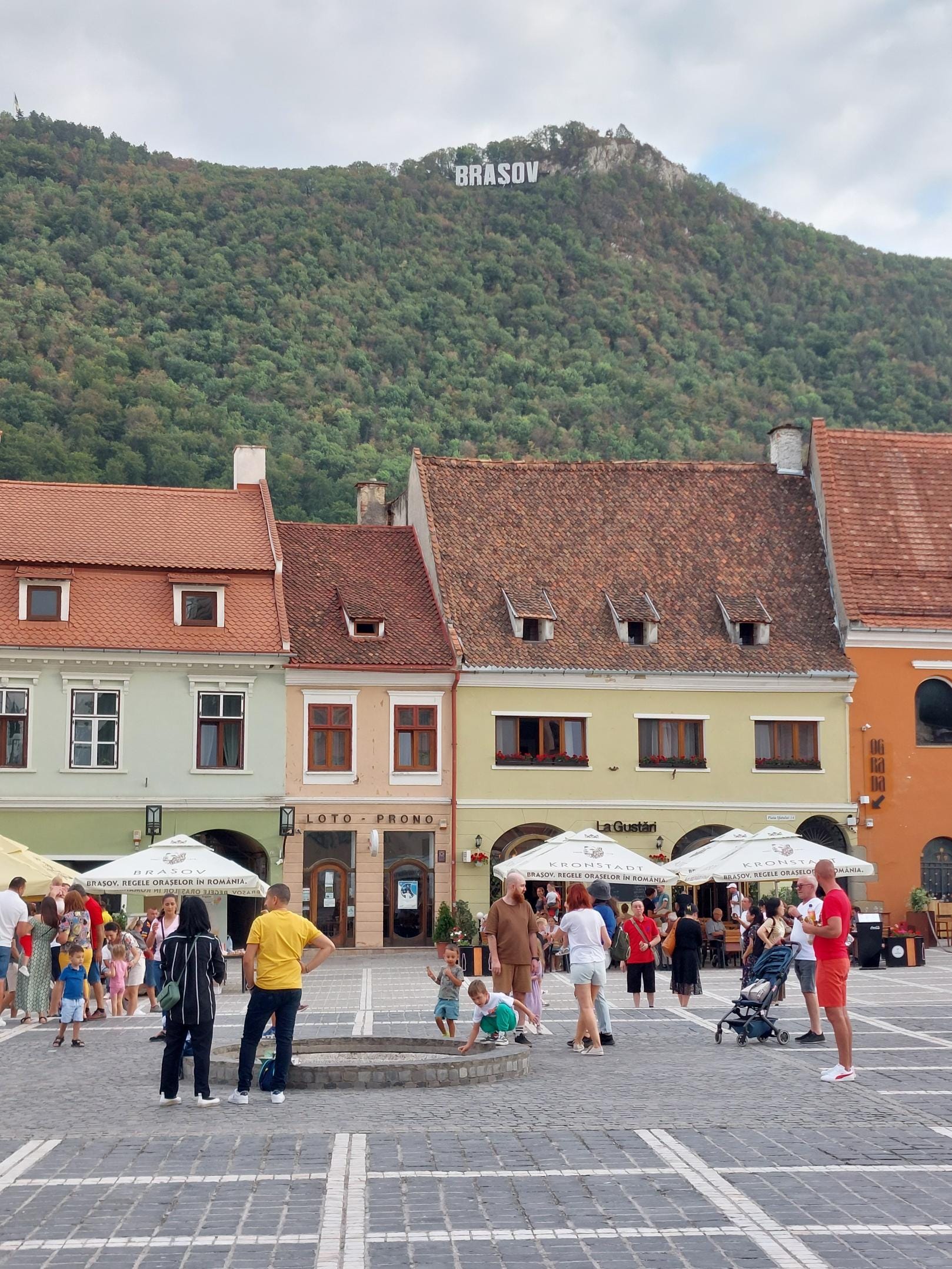
The aging train rumbled through Romania’s picturesque Prahova Valley for the one-hour jaunt from Sinaia, a mountain resort and former royal retreat, to Brașov, a charming, medieval city in Transylvania. Alpine air mercifully cooled the unairconditioned passenger cars on a warm day.
Twenty-three summers ago, I was serving as a Peace Corps Volunteer and starting my second of two years in Romania. One of my best friends, Frank, had traveled from Washington, D.C., to visit me and check off yet another country. The day before, we’d taken a train from sweltering Bucharest to Sinaia and nearly died of suffocation, not only from the lack of AC but the full-throated resistance by fellow passengers to crack any windows due to the dreaded curent, a draft caused when two windows are open in the same room, car, bus, train or wherever.
Curent is feared by millions of Romanians, who believe deeply that such a breeze – perceived by Americans and other foreigners as relief – causes headaches, toothaches, back pain, colds and other maladies.
The same situation days earlier on a bus at the Black Sea nearly tangled us in fisticuffs when Frank opened a window and a few Romanian men grew irate.
Peace Corps staff had schooled us on curent, but our immersive language training, mandatory and useful, didn’t offer any magical lingo to deal with it.
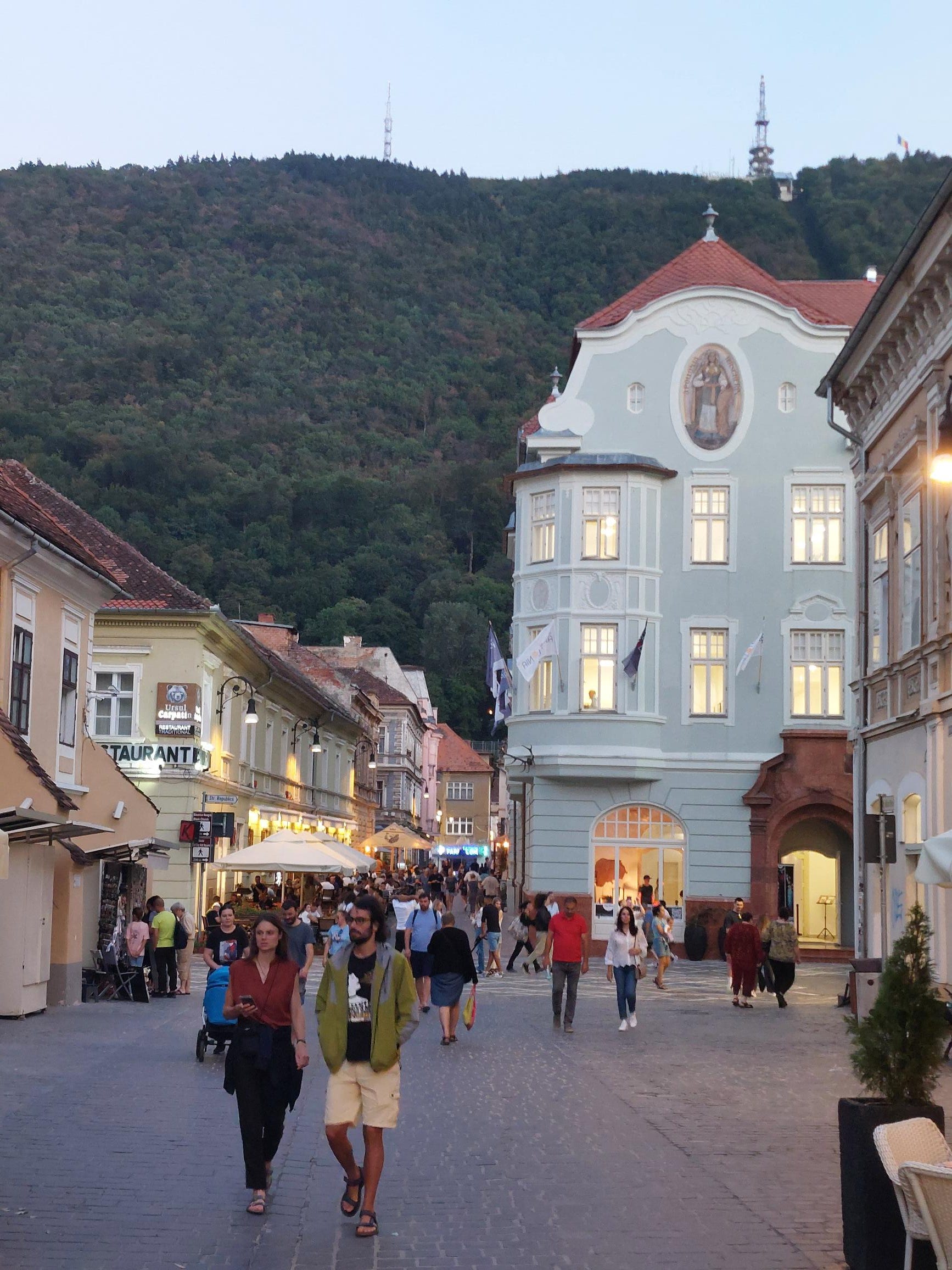
Sitting back and admiring the steep, jagged Bucegi Mountains, I prepped Frank on Brașov, one of my favorite Romanian cities. During Peace Corps training a year earlier, in the gritty oil town of Ploiești, I accompanied a few volunteers to Brașov for the first time. As we entered the main square, one remarked, “Wow, I finally feel like I’m in Europe!”
The train churned northward, weaving and bobbing slightly. As we chatted, a middle-aged woman across the aisle with whom we’d had zero interaction, suddenly corrected me.
“Brașov!” she exclaimed, mildly annoyed, enunciating clearly the sound “brah-SHOF.”
Frank and I looked at each other quizzically. It sounded nearly identical to what I’d said, but I tried to appease the woman, who reminded me of actress Bea Arthur and her TV characters, Maude and Dorothy.
“Brașov!” I replied, enthusiastically, striving for correctness. She shook her head in immediate disappointment.
English speakers tend to say, “BRAH-shof” or “brah-SHAHV,” but I thought I had it right. We went back and forth like ping-pong: Brașov-Brașov-Brașov-Brașov. Failing to meet woman’s expectations, I moved on, mimicking her classic, accentuated Romanian shrug. Frank and I still laugh about it.
Fast-forward to today’s Romania, where I live again, this time for the past decade. Recently, I entered a bakery in Timișoara, in a former mini-market space near my former Peace Corps job. The 40-ish clerk is a familiar face and accustomed to my accent, so I thought, even if she’s rarely exuded an ounce of warmth.
I ordered a loaf of bread and three pieces of pumpkin strudel. In Romanian, it’s ştrudel with the ş pronounced with a “sh” sound. I am fluent in Romanian, speaking reasonably well – markedly better than in my Peace Corps days – but with pesky mistakes, as my Romanian wife reminds me, but I know the ş.
The clerk asked me to repeat my order three times.
“Ooo, ştrudel,” she said, dramatically emphasizing the “sh” sound, adding, “Nu v-am înțeles.” “I didn’t understand you.”
Of course, she didn’t.
Most of the time, fortunately, I don’t have such encounters. Sometimes I wonder, what if I lived here not knowing Romanian? Without a shared language, we have nothing.
Nowadays, most Romanians under 40 probably speak English, either fluently or enough to manage. I’ve often admired Romanians’ knack for languages, with many speaking three or four. Being a Romance language helps, while many Romanians have told me they learned English from cartoons and YouTube.
It’s possible for foreigners to live in Romania without speaking Romanian, especially when English is a common tongue, but I couldn’t tolerate living in that bubble.
I’ve done two interviews on TVR, Romania’s state broadcaster – one of them in-studio on live national television and one extended conversation for a profile, plus a live, hourlong radio show in Timișoara that also streamed in video. All three were entirely in Romanian. I barely went back and watched them as not to cringe too much at my stumbling, but I managed to answer the questions without making a total fool of myself.
Would I have communicated differently, perhaps more confidently in English? Indeed. That’s an invisible limit that I’ve yet to overcome, and probably never will. Then there’s body language.
I’ve heard people say how their mannerisms or even personality can change while speaking a foreign language. Not in my case. For instance, Romanian men will talk right in your face, so close you can smell their breath, even putting their arm over your shoulders – and they’re not even mad. It’s endearing, but a personal space violation for an American, though I’ve learned to tolerate it.
The more I speak Romanian, the more I marvel at its beauty. Not quite as melodic as Italian, but similar, with quirky Slavic components and a smattering of Turkish, it’s also crazy clever in its nuanced humor – and especially challenging idioms – while remaining wholly phonetic.
But when I’m with a group of Romanians around a table, and they’re all talking, often over each other, it’s difficult. That’s when the conversation transforms into noise, especially if I’m tired. It can be frustrating, just as when I don’t know a word and miss the overall meaning. Those are the moments when I just want to crawl away and hear English.
Speaking Romanian to a stranger who’s not used to me, I sometimes get a furrowed brow or sigh. Often, though, they’re pleased with my effort and even complimentary. The former are the ones who typically respond in English. But I stick to Romanian, on principle, trying to push my limits.
I think even “Dorothy” from the train would agree.
Author bio:
Andy Trincia is an American writer and editor living in Romania after a career in journalism and corporate public affairs. A former newspaper reporter in Kansas, North Carolina and Virginia, his work has also been published in The New York Times, Philadelphia Inquirer, National Geographic Glimpse, Imagine5 and Carolina Alumni Review. Andy is a TEDx speaker and served as a Peace Corps Volunteer in Romania. He holds a bachelor’s degree in journalism from the University of North Carolina at Chapel Hill and MBA from Northeastern University in Boston. His blog, “The Neighbor’s Goat: An American in Romania,” is on Substack.

I love this piece. Language is so complex, and we are definitely different people when we try to communicate in another one. When I speak French (not well because it’s been 30+ years since high school!), I inexplicably have a lisp that I don’t have an English. I, too, hope strangers appreciate my efforts, lisp and all!
My hometown!