

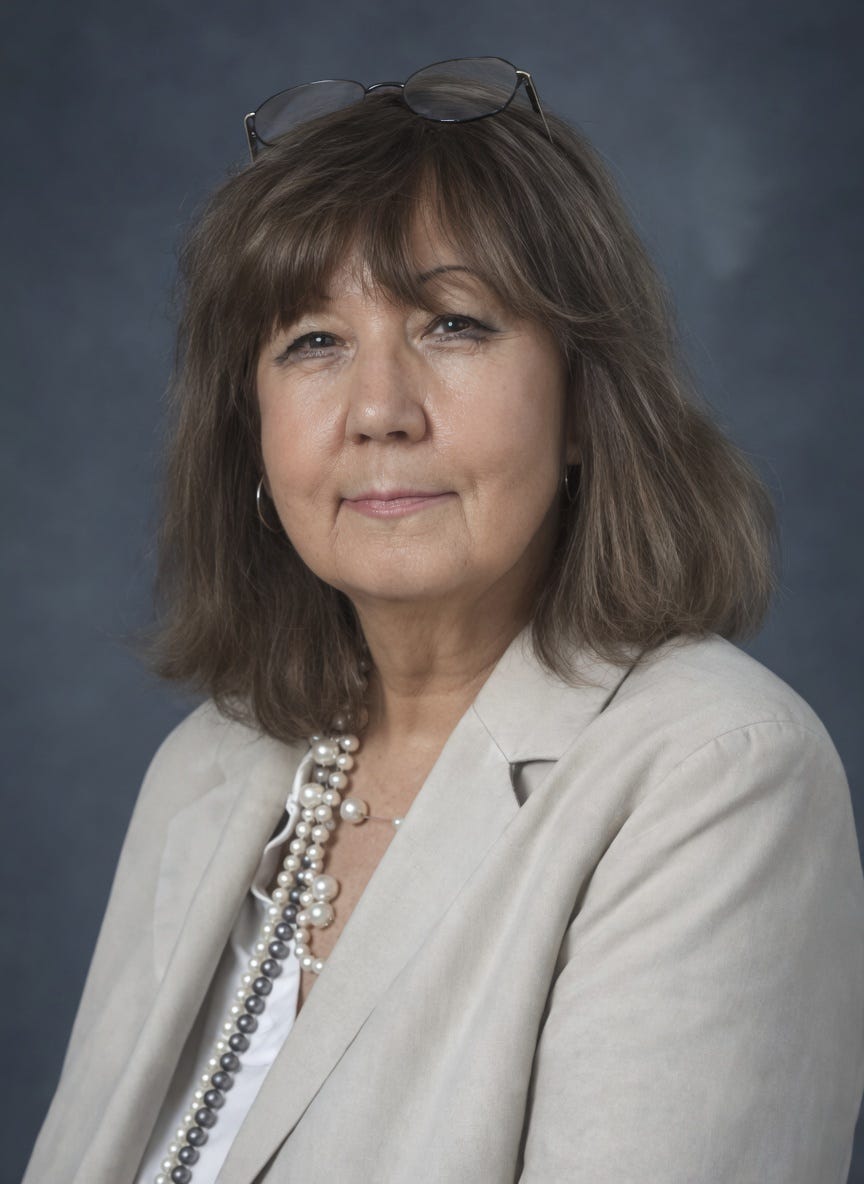
Doina Ruști: “Nearly Everything I Write Eventually Reaches the Roots of Evil”
Balkanism as Inheritance
IM: In a landmark book on the Balkanism of Romanian literature, the late Mircea Muthu devoted a chapter to your work. His references are to The Phanariot Manuscript, but not only. Do you believe in a Balkan dimension of Romanian literature?
DR: I believe in inheritance, and yes, as someone born on the banks of the Danube, I do feel connected to the Balkan world.
IM: In a recent monograph dedicated to your work, Pompilia Chifu says that one can speak of a folkloric vein in your writing, with a spectrum that includes both Balkanism, in the line of Milorad Pavić, and traditional Romanian myths. Does this observation seem accurate to you?
DR: Her book is the first study to cover almost all of my novels, and the statement is supported by detailed analysis, especially where she discusses my ethnic connections. The folkloric symbolism is Romanian, from the recipes in The Book of Perilous Dishes to the stories inserted in Nas de bulgar (Bulgarian Nose). I believe the imaginative core of Romanians is narrative, largely solar, but also marked by a Bogomil-type dualism. In my case, this vision is connected to my historical and geographical position, to Danubian folklore.
IM: As you say in one interview, many threads bind you to the Balkan world:
DR: “Some of my ancestors came from Montenegro; they were Aromanians, most of them bakers or travellers. Others were Turks who settled in the Romanian Principalities after the Treaty of Adrianople. But there were also many native Romanians, on my paternal grandmother’s side, whom the eighteenth century found as vineyard owners and small merchants, people with resonant names ending in -escu, Southerners, full of Phanariot indulgences.”
IM: In The Phanariot Manuscript, each chapter is connected to a common noun, as a vast receptacle of the Balkan and Romanian world:
DR: “In his head, the name rang out, shouted by her furious mouth, while her green eyes cast down a shower of stars. Tranca’s filthy mouth was Maiorca’s mouth, the one he had kissed. No word had ever entered his blood as deeply as the name she had given him. Leun was his hidden name, which only Tranca, with her snake-tongue, had known how to ferret out. And this name stirred through every nook and cranny, like a breath, like a rustle, like a collective sigh. In his blood, this name had bred its brood, had laid the foundations of a tribe. Clouds floated over the Dâmbovița, and in the distance the elderwood stirred. Leun opened the window. From the river mud, the smell of the city rose to his nostrils, and from the elder bushes, small mouths called out his name.”
— The Phanariot Manuscript, p. 439
IM: It seems to me that here Balkanism is no longer merely atmosphere, but a form of symbolic birth: the name enters history. Is this how you see the connection between name, place, and destiny?
DR: Each chapter of the novel is connected to a word that valorizes an important part of Romanian history. Among them, “amăgire” — illusion, seduction, being led astray — seems especially revealing to me: a word with a long history, originating in Greek and passing through Latin, defining for the metaphysical side of Romanians. In the novel, it is linked to the story of a tailor who travels across the Balkan world, crosses the Danube, and is lured by a song about Bucharest.
IM: This is probably where the imagistic explosion of The Phanariot Manuscript comes from, as well as the epic architectures of your Phanariot trilogy. There is also, unquestionably, a folkloric culture, visible from your earliest novels. Alex Ștefănescu noted, for example, that Zogru is an autochthonous spirit: “Zogru is at once a spirit, a devil, a vampire, a werewolf, something of all of them.” Does Balkanism have more to do with geography or with mentality?
DR: People have often spoken about the Balkan side of Romanian literature, in the sense that geography and neighboring cultures determine mentality and, implicitly, literary themes or manner. As a country situated at the Gates of the Orient and on the border of the Balkan world, it is natural for Romania to have something of each. But we should not forget that the Romanian world also carries Mediterranean inheritances, an entire history of travel north and south of the Danube, as I say in Nas de bulgar and in Ferenike — inheritances that have generated a vast imagery.
The Balkan Imagination
IM: Are you referring to a particular kind of imagination — a mixture of irony, fatalism, and exuberance, as the interwar writers used to say?
DR: Not quite. Exuberance, yes. A certain solar quality, a type of aspiration, even a belief in the future, as absurd as it is powerful, almost fierce. I like to write about the chaotic dimension of the imagination, about that kind of absurdity stored, for instance, in the prototype of the Spân, the hairless trickster of Romanian folklore.
Individual History
IM: In the novel Ferenike, you created a North-Danubian space dominated by phantasms. I am thinking now of the red petals in the mill, the waters, the light of the South, and even the women like balloons carried off by the wind of history. I would like to pause on this last image: is it part of the Balkan imagination? Does the value of immediate history prevail?
DR: “...I saw them lined up along a string that ended in an enormous balloon — a pregnant belly — on which the hand of history had written, in stark black capitals: Saigon.”
— Ferenike, p. 186
It is a vision that represents me. In many of my writings, reality, especially reality with a Zolist potential, develops along the line of the fabulous — not a fabulousness of folkloric origin, but one descended from a series of symbolic associations. Here, the image fixes the tragic nature of a concrete social situation: Ceaușescu’s anti-abortion decree. It is the 1960s, and the entire universe is populated by pregnant women. It is an image from my childhood, a kind of emblem of the early Ceaușescu years.
Femininity and Historical Trauma
IM: The theme of abortion appears in other works of yours as well, for instance in The Ghost in the Mill and even in Zogru. Why did you choose it?
DR: It is a kind of emblem of the communist history in which I had the misfortune to live. Almost everything that happened during the dictatorship revolved around the obsession with birth rates, around the slave-like mechanism branded by Ceaușescu. More precisely, it is about the mutilation of intimacy, about reducing women to their reproductive role. But other evils followed from this: the transformation of social mentalities, propagandistic motherhood, the myth of the heroine mother, all gradually leading to the degradation of the family as an institution.
IM: Perhaps you underline this idea most powerfully in The Ghost in the Mill, where a young schoolteacher is raped, forced to abort, and then thrown into prison because she had an abortion. The scene in which she is arrested, followed by a soldier carrying the plastic bucket with the aborted blood, is emblematic of the theme.
DR: “On the ground, reddened by brick dust, broken ailanthus stems showed here and there, and Rafailă’s fence lay flat on the earth as if a typhoon had passed through. And then, after she looked to the right and to the left, without seeing the people who had stopped by the roadside to watch her go, tears began to slide down her pale cheeks like drops of arsenic. In the evening light, Lucica made her way along the weathered road, and behind her walked the sad soldier, carefully holding in his right hand the blue bucket of her guilt.”
— The Ghost in the Mill, p. 420
Through the character in The Ghost in the Mill, I tried to speak about the essence of communism, but above all about the causes of the misogyny produced by communism. There would be much to say. For me, the 1960s and Decree 770 contain the seeds of a national trauma, which culminated in the fierce and generalized desire to kill the dictator. I say this in several of my novels. I lived through that period and cannot set it aside. Nearly everything I write eventually reaches that place, the roots of evil.
IM: When you say that, I immediately think of Lizoanca, a kind of quintessence of toxic history. Is literature a historical reconstruction? A personal reconstruction? Or merely a vehicle for transmitting a message? I am referring to the feminist message of your writing.
DR: A writer is bound to a history. But literature expresses first and foremost the personality of the person who writes. No matter how mimetic a novelist may be, they leave their imprint on the story. I have always been a rebellious being, somewhat anarchic, a trait I believe all orphans share. My public biography is tied to the recent history of Eastern Europe. I lived under communism, I went through a major political trauma — the assassination of my father — and I took part in the Revolution of December 1989. This experience is not merely a biographical element, but a source of inner authority for my writing.
At the same time, my personality is equally grounded in classical culture, a kind of measure of my discipline.
Classical Culture and Inner Demons
IM: After recounting the assassination of your father in Ferenike, in your recent novel Nas de bulgar you write about your formative years in the Latin and Ancient Greek section of a high school in the 1970s. Among other things, you speak there about the foundation of your education, but also about your encounter with Ferenike. What importance did this encounter have in real life?
DR: Ferenike was initially a name from a Greek lesson. It seemed mobilizing to me, but above all I saw it as a kind of treasure chest, a vessel in which all victories were kept, because Ferenike means “she who bears victory.” In time, however, it became a demon. I came to identify it with the demon of death, the only victorious one in a limited world.
The Women Who Survive
IM: Still, a female demon. There is a strong female line in your books: vulnerable women, but also women who resist, who pass on memory, energy, sometimes even a form of magic. Are you more interested in women’s suffering or in their capacity for survival?
DR: I do not think I treat them as a category. I am a woman, and it seems natural to me to express a vision that is mine and to create characters that complete me. My women are generally survivors, because that is also my nature. But beyond the “source” lies narrative development. Despina, from Homeric, fascinating, seductive, desired by everyone, gradually moves toward the symbolic realm, leaving behind only the myth. Mărmănjica, along a fantastic line, and Lizoanca, along a realistic one, are prototypes of the idea that does not die. Although they seem different, both accumulate a magical and imperishable evil.
IM: Is there a female character you feel especially close to? One you value as a human or symbolic prototype?
DR: Usually, the most recent characters continue to preoccupy me. Since I have only just published Nas de bulgar, I would mention Detustaina. She is a peripheral character, but she has something of my own desire for freedom. I took the name from a Dacian inscription discovered by Pârvan in the Severin area. I liked its archaic sound, but gradually it came to life and became a wandering warrior moving through the Balkan world.
Identity as Story
IM: Speaking of Nas de bulgar: is it a continuation of the novel Ferenike?
DR: Yes, it belongs to the same series of the autobiographical novel. If in Ferenike I spoke about the demon of death, here I speak about the demon of love. But throughout the novel, I also inserted eleven stories about the archaic history of the Romanians.
IM: Why? What was the intention behind these insertions?
DR: Since in Nas de bulgar I continue to narrate my Iași period, it seemed natural to me to add a kind of homage to the Iași school, obsessed with ethnogenesis and with Al. Philippide’s The Origin of the Romanians. In a sense, my first love story was an act of self-discovery and a return to general origins, convinced as I was that personal identity and national identity are decisively connected.
The Art of the Novel
IM: The eleven histories in Nas de bulgar seem at first unrelated to the main narrative thread, only to connect very subtly with the action later on. It strikes me as an unusual narrative technique. So I will ask you: is it still possible to write in an original way? It has been said of you that each of your novels has a different narrative technique. So, if I were to ask someone how one can write something new today, I think you would be the right person.
DR: Every story has its own pattern, which is born as you tell it. There are no recipes. I do not believe in them. But there is a voice belonging to each narrator who, let us not forget, is “someone else” in every novel, shaped by their empathies with the characters and by their invisible ties to the story. Even if all my novels have the same author, each of them has a different narrator. I have said this before: for me, writing is not a mission or some crusade against demons, but a game, an elegant one, which transforms me, as narrator, into a ubiquitous, metamorphic being, an Odysseus whom Homer himself called the polytropic man, precisely because of his epic ability to transform and adapt.
IM: If you were to say what remains, beyond each individual novel, from this passage through history, myth, femininity, and identity, what would be the ultimate stake of your literature?
DR: I believe the stake remains the story. Not history in itself, not trauma, nor myth, but the way all of these are transformed into a story capable of holding you, of reaching an ending worthy of being remembered, and, more than that, of surviving. Literature’s role is to delight, while hypocritically
Read more about Doina Ruști and her work: Doina Ruști