


June began with a bang for ARCS and our community: a book club meeting on Zoom with novelist Doina Ruști. More than thirty people joined us on a bright, sunny Saturday morning in Seattle. I mention the weather because, as many of you know, cultural institutions here plan their programs only after consulting the forecast: if it’s sunny and playful, the Symphony plays Rachmaninov—Rachmaninov, like Tchaikovsky and Beethoven, sells tickets; if it’s rainy and gloomy, they play anything else.
So the fact that it was a sunny Saturday, a day when most Seattleites head straight for the mountains, made the turnout even more remarkable. Instead of hiking, people gathered to talk about Ferenike.
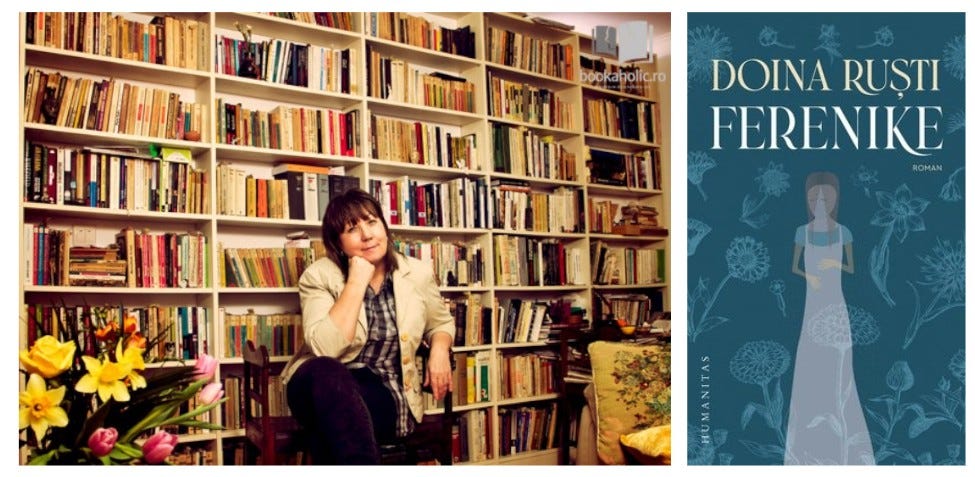
The lively, intense, and friendly exchange of ideas led to something none of us expected: emails, WhatsApp messages, and Instagram notes asking when the next book club would be and whether we had a summer reading list. How could we resist such an enthusiastic crowd? We put a list together—and uploaded it.
The next challenge was answering the practical questions that followed: “How can we get the books?” “Is anyone traveling to Romania to buy them?” and “Why can’t we order them on Amazon?” The first two are easy: ARCS members who travel to Romania will bring copies back to Seattle and add them to our online library so you can borrow them.

The third question has a less satisfying answer: major Romanian publishers do not collaborate with Amazon. It has something to do with legislation, but mostly with bureaucratic headaches—ones that a few overworked clerks would rather avoid.
Almost at the same time, Bookfest opened in Bucharest, where dozens of Romanian authors presented their newest books to the public. If 455 events and 158 publishers under one roof sound impressive, just wait for the Frankfurt Book Fair 2028—where Romania will be the featured country there. Back to Bucharest: the Guest of Honor at Bookfest 2026 was Georgi Gospodinov, whose powerful novels have been translated into more than twenty-five languages.
His most recent novel, Time Shelter, first published in 2020 and translated into English two years later, received the prestigious International Booker Prize in 2023. I should add that this novel is already on my students’ reading list for next spring quarter.
After a thirteen year gap, Frankfurter Buchmesse returned to Bucharest, noting in its statement—posted on Facebook—that “international book fairs remain essential spaces for turning ideas into future collaboration, because strong international partnerships are built through continuity, shared passion, and mutual commitment.” The Buchmesse also announced that Romania is “on its path toward becoming Guest of Honour at Frankfurter Buchmesse 2028: the journey begins with listening, exchange, and relationship building, and has the greatest impact when it is understood as a multiyear collaboration rather than a single event.” Wonderful news for anyone who loves Romanian literature, whether in the original or in translation.
June also marks the moment when American publishers launch their new titles. On June 1, The New York Times listed twenty-eight books that will soon be on bookstore shelves.
Amid the noise of the big book fairs, Sanda Berar’s black-and-white illustrated volume feels like a breath of fresh air. It is not quite fiction, nor poetry, nor drama; it is a woman’s transcript of the words she never utters. Structured in five texts followed by a final “chapter” of illustrations, the book becomes an installation of magic mirrors—reflecting not the characters’ appearances but their inner selves.
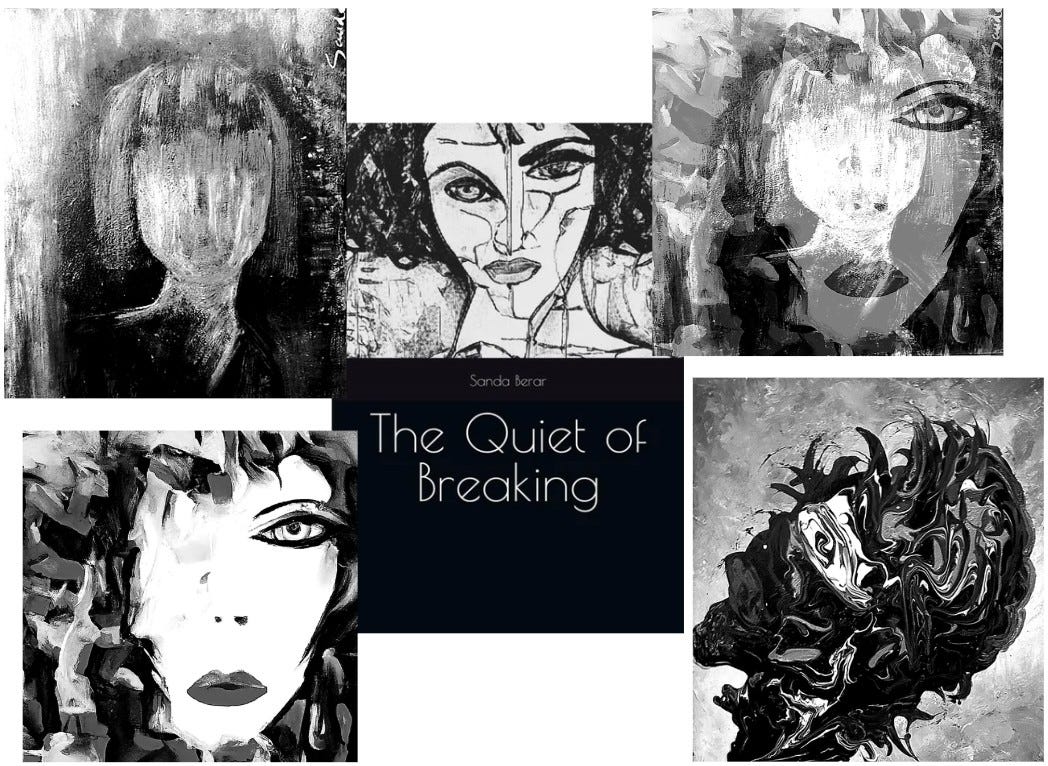
The Quiet of Breaking also works as a divination device for readers: from the first page, we are invited to choose the section that matches our momentary state of mind. Sanda gently tricks us into a nonlinear, nontrivial reading experience— as Espen Aarseth calls the act of reading that is not sequential. I resisted the invitation and read it straight through, from chapter one to five. Each of the five chapters—Blindness, Rupture, Endurance, Aftermath, Stillness—records fragments, or shards to echo the title’s metaphor, from a woman’s life from infatuation to divorce, from the fears of motherhood to the painful acceptance of aging, from the comfortable routine of marriage to the instinctive sense of another’s intentions before they are spoken. Recovering the most honest words—the ones a woman never discloses, the ones meant only for herself—Sanda Berar writes about true feelings, ordinary relationships, and readings and misreadings of people, gestures, whispers, and silences.
I have not identified with a character so strongly in a long time. Here, I saw parts of myself in every woman portrayed. Most strikingly, the book made me wonder whether I, too, have begun “living inside a photo.” I hope not—but I urge you to see whether this might be true for you as well.
Add this book to your summer list!