

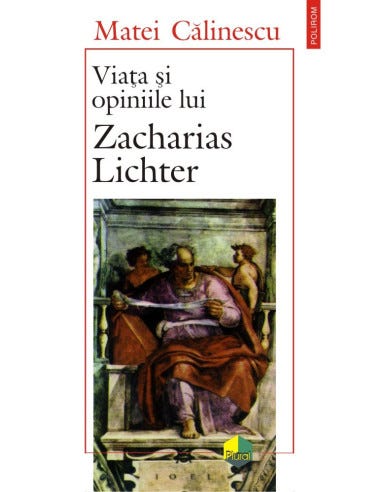
Among the books that help me understand and face the world as it is today, I count a small volume by the Romanian literary critic Matei Călinescu. Published for the first time in 1969, this book weathered the passing of years, changes of regimes, the progress of society and technology, to emerge for me in 2026 as a testament that nothing really changes our human condition and that we cannot really overcome our alienation from a world that’s continuously slipping away from our grasp. The most we can hope for is to reach a state of “perplexity”, where we suspend our attempts to explain our perception of reality.
To read Zacharias’ opinions – and he does have an opinion on everything concerning life – is to shed all pretenses, all that is fake and shallow, and strive to understand ourselves and our world from within. How much easier it would be to have the ability to stand outside our world and observe its beauty and its absurdity. Only then could we take it all in. Zacharias thinks there is yet another way, through madness.
Zacharias is introduced to us as a highly intelligent, highly educated individual who is nevertheless a misfit in the society of his time and would be just as much of a misfit today. The carelessness of his appearance would revolt us today just as it did fifty years ago, and he would appear just as mad in his behavior and discourse. Zacharias chose to discard all social conventions but not his humanity.
He is trying to use words and body language to bring us the message of warning against our march of progress and its path to complete alienation. Unfortunately, these attempts are unsuccessful. All we are able to perceive is his insanity: “Words burst from his mouth in torrents, accompanied by miming and the disturbingly wild gesticulations exhibited by madmen determined at all costs to convince their listeners.” (Călinescu 5)
What appears as madness to us allows Zacharias to illuminate the truth in a way that is not possible through language. Language can only take us so far, but a barrier remains between the speaker and receiver. The more we try to explain through words, the more generic and abstract the words become, the less we convey and the more we distance ourselves from reality. Zacharias’ sometimes language-less and unconstrained madness allows him to bridge this chasm. He is shining a light on the rift we have created between ourselves and our world which is a source of suffering that manifests as alienation, lack of meaning and a mental health crisis: “Any form of consciousness, no matter how limited, implies duality: madness is unification. It seems that the more acutely people suffer from the painful contradictions of their conscious mind, the stronger is their longing for madness.” (Călinescu 9). The contradictions he refers to are the paradoxes we’ve created that are leading us to an existential crisis. We long for a return to a unified experience with our world but we can’t seem to figure out that our methods are in fact the very thing that’s making us drift further into the absurd.
Through Zacharias eyes we see that our modern alienation is not that different from the oppressive, communist Romania of 1969, if anything we recognize so many of its characteristics all around us. We are experiencing a “spiritual alienation based on the intoxication of risk.” (Calinescu 18) but we lack true courage: “Modern societies tend to eschew responsibility, at least as a factor in human interaction, and replace it with the manifold and diverse forms of the cult of risk-taking” (18). We can see evidence of this in every excuse we have ever made to justify the technologies we’ve created, even when they work against our well-being. In fact, it has become more acceptable to speak against people than against technology.
We value novelty over creativity and seek to monetize any and every scientific discovery even if it gets us closer to self-destruction: “The rare and brilliant act of creativity becomes a ‘fiscal gain,’ a source of profit, exploited with patience and deftness” (Călinescu 20). The aim of progress has become all encompassing, so much so that it’s threatening our well-being and mocking our intelligence, elevating stupidity in its wake: “Its vulgar hypostases aside, one can say –- as paradoxical as it sounds – that by assimilating the discoveries of intelligence and by mimicking its manifestations, stupidity contributes to the progress of humanity” (20).
Zacharias is the ultimate rebel who reminds us that progress requires all of us to sign up in its support, to accept the idea of work, its hierarchy, and to conflate “having” with “being”. We cannot be partially subscribed to progress because it requires all of our resources. Zacharias is trying to unsubscribe, renounce all material possessions to get to the essence of poverty and transcend it but even that requires striving on his part, which eventually leads him to the mediocrity of being like everyone else: “The devil illustrates the impossibility of being, as well as the awareness of the impossibility – the source of mediocrity in the universe” (Călinescu 30). Anyone who’s recently tried knows that the social structures we’ve created make it impossible to simply exist without participating. It’s not easy to just be, we have forgotten how to or maybe we never fully knew.
To the 1969 reader, Zacharias’s musings might have read like veiled criticism of the society at the time. In 2026, we cannot fail but recognize ourselves with even more clarity, his prophetic wisdom illuminating so many aspects of our world that leave us perplexed. Our obsession with making the world a better place seems to always be out of our grasp. Somehow our best intentions and ultimate truths do not seem to have any practical applicability, whereas lies always give results: “In fact, the application of a false idea may yield more practical results than the application of a true one (since truth offers more resistance to such endeavors)” (Călinescu 31). We experience this paradox in the way we seem to find more profitable applications of our technologies for exploitation and manipulation, even when the science that got us here was for the greater good.
We have distanced ourselves from our humanity through what Zacharias sees as the “Crime of ‘Analysis’”, by rushing to use all the tools at our disposal to dispel all our myths. We no longer trust our past, our elders, our history and all its wisdom, but very readily trust our technological creations to piece together pieces of known elements that give us the illusion of controlling the universe: “All that is indecipherable, unique and mysterious in a human being, all that pertains to the essence of the great existential paradoxes, has become the target of a hidden aggression, of a glacial ferocity consisting of analysis and reduction to the already known: tools made more efficient by the greater abundance of the elements of the known, allowing for a larger number of possible combinations” (Călinescu 59). In our rush to explain and manipulate the world and our place in it we have abandoned our intuitions and empathy and have embraced hubris. We are employing what we now think are our best tools: algorithms and data collection to chop up reality, flatten it, remove its context and package it as our best accomplishment.
Zacharias would not have been surprised at all, that we seem to be uprooted, global and virtual citizens, preferring to be tourists, seeking meaning and fulfillment elsewhere. In fact, he predicted that we would end up “turning the world into a variety show” (Călinescu 55). From our “preventive hypochondria” (65) to our hard-to-pin anxieties, from the efforts to extend the average life span to genetic engineering, Zacharias is warning us that we have traded our soul for comfort.
We could think of Zacharias Lichter as a prophet or simply someone who saw clearly both the past and the present, and was able to extrapolate the future. He strikes me as someone who was willing to call things out for what they are, who knew where to look for wisdom and was not afraid to embrace perplexity. The fact that he chastises his biographer in the end makes it clear that he has no illusions that anyone will heed his warnings, that anyone will care or even read the book. After all, we’ve had warnings before and since, but we’re not deviating from our path of progress, and we are not abandoning our hubristic approach.
Zacharias is just the observer who took it upon himself to give up modernity and its possessions, to live outside the social constructs, outside the hierarchy, so he could tell us what he sees behind the curtain. It’s up to us to read the book, hear his words and maybe for once embrace reticence which could help us find the path to just being.
