

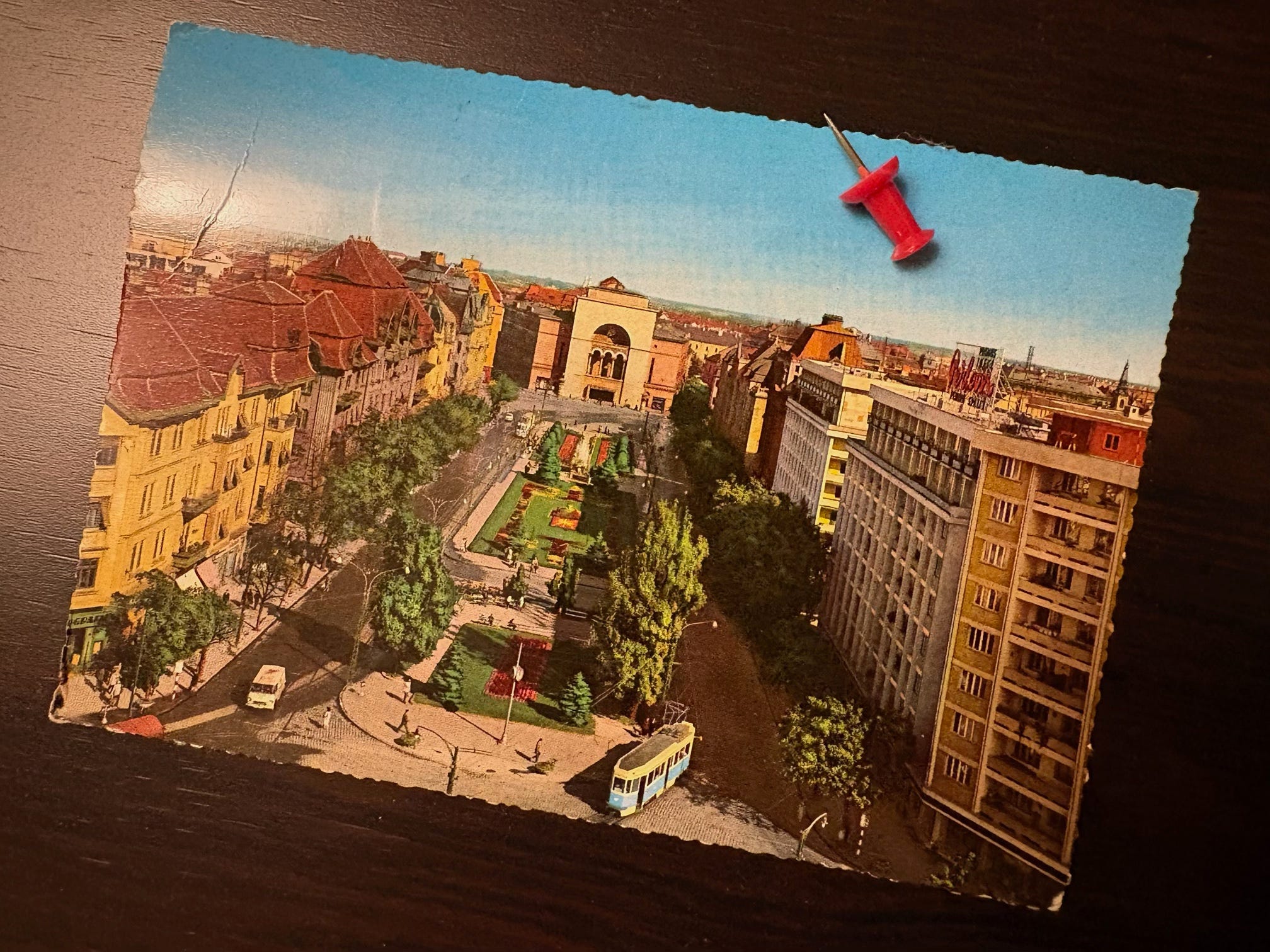
As my thoughts drift to the realm of childhood, I summon long summer days with no beginning and no end, elixirs served in glass jars fed with sugar that I am told are life-changing, dusty bookshelves where mites build civilizations, mysterious tesseracts drawn on graph paper by a child’s hand, classrooms with the smell of newspapers and the sound of bottles and jars that are ready to be given some kind of new life.
It has been three years since I read Solenoid by Mircea Cărtărescu, and only now have its pages resurfaced in my consciousness. It’s a bit hard to say what was in the book and where my childhood memories seeped in. The truth is that ever since I finished reading Solenoid, its imagery keeps returning to my mind. One photographic image at a time: the world of School 86, the drawer of childhood artifacts, the fantastic worlds of the Picketists, the hypnotically bizarre universe of mites and the decay of buildings and people alike have colored and rearranged some of my childhood memories and I fear that just like the character in Solenoid I too am succumbing to the belief that they are suffused with a dreamlike quality. I am tempted to re-open the book and confirm my suspicions. Was Solenoid the source of all these thoughts or did my unconscious mind make them up?
I know for a fact that I never inhabited the world of mites, but I have often felt, viscerally, the need to break through the layer of dreary reality through fairy tales and figments of imagination. Endless strings of lonely days spent in the imaginary world of books loom large in my memories. Solenoid’s librarian Palamar reminds me that the possibility of 50,000 species of mites coexisting with our world — much like the proliferation of storyworlds in books — offers a multitude of alternate universes each with its own struggles, myths and escape hatches.
Growing up, I did not have an abandoned factory to get completely lost in, but I did have half-finished construction sites and rusty abandoned trucks to explore. In retrospect it’s hard to say whether those spaces were truly infinite; in my mind, they simply stretched on, revealing new realms day after day.
In other corners of the mind, there were whispered discussions of the metaphysical long into the night around the campfire, but who can remember if there were ever any answers by the next morning. We were seeking evidence in yellowed, dog-eared, photocopied books of Rudolf Steiner to make ourselves believe in the existence of something else. “I want to believe that things exist,” says Irina, Solenoid’s physics teacher, and like her we hoped that our times might just have been an illusion.
There was no solenoid that I can remember, but one might as well have been built in the dusty, crowded rooms full of electronics and clouds of soldering iron fumes that lifted from my father’s worktable
I cling to one memory of tasting the slightly acidic liquid that my mother poured from a jar of sugary water and coaxed me to drink. “It hasn’t harmed anyone” was good enough for me. I look at the “crystals” left behind in the jar. They will soon get fresh water and sugar, and I think there are so many more than last week and soon they’ll need a new home...
The possibility of a Mrs. Bernini, Solenoid’s music teacher, distributing these jars in my childhood town takes root in my mind. I decide to find evidence of the self-regenerating algae cure that I shared with Cărtărescu’s characters, which was nothing more than a bacterial culture grown in a jar of sugary water. There is not much information about this, other than a cursory mention that such jars were in fact circulated in the 80s in Eastern Bloc countries. This bit of knowledge grounds me. It might be safe to re-open the book and search again for the memories it left behind.
Every book speaks to me on a different wavelength, leaving its imprint sometimes like rings on a tree and other times like layers on a palimpsest. In Solenoid I found the building blocks of an origin story—a confirmation of vague impressions, dreams, and fears that I can no longer fully trust since they appear nowhere in photo albums or letters or any family artifacts. I come from that world and carry it with me.
