

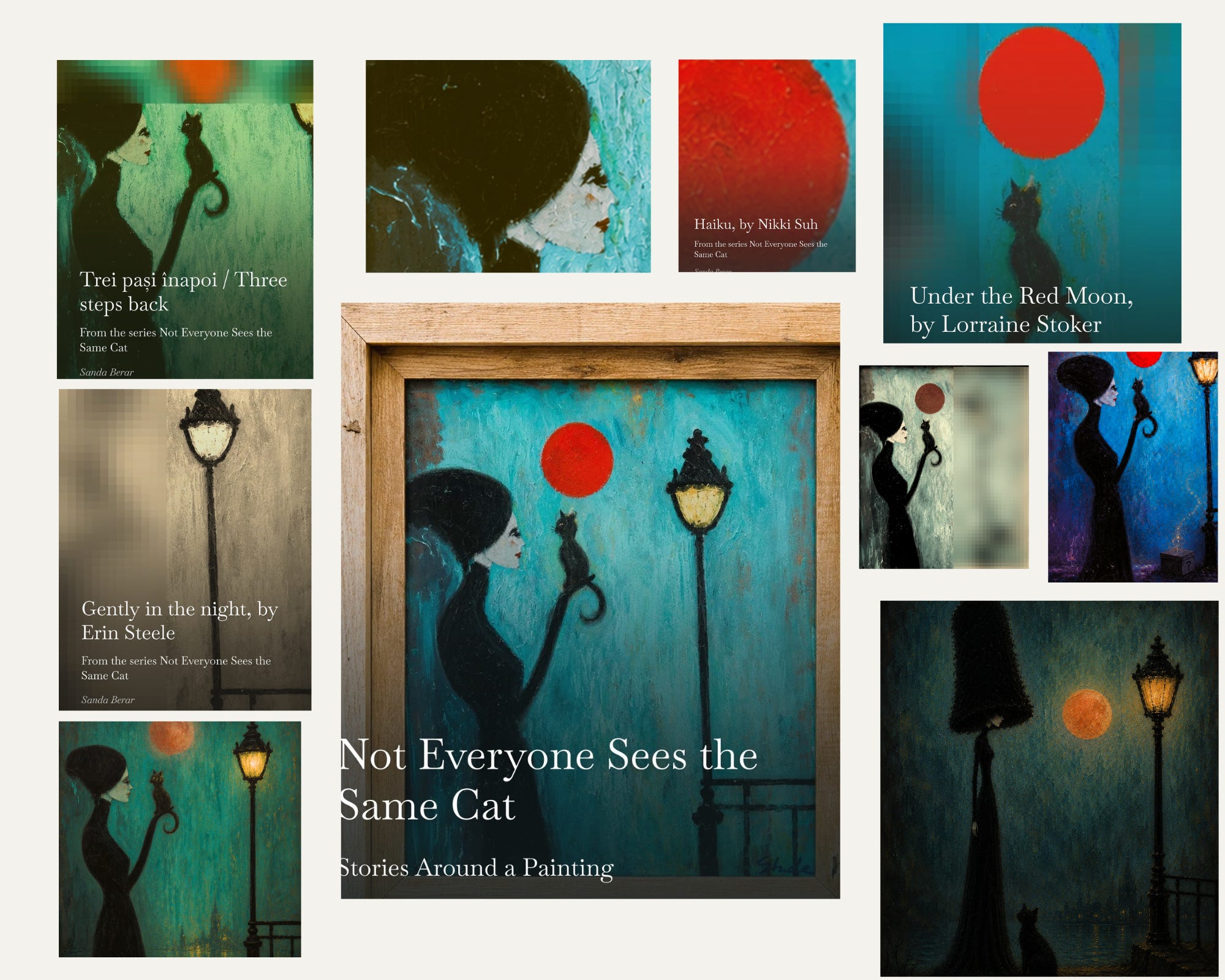
A few weeks ago, we started a small creative experiment around one painting.
A woman in black.
A cat.
A red moon.
A streetlamp.
We invited people to write whatever the image suggested to them: short fiction, poems, strange ideas, memories.
What happened next surprised us a little.
The same painting began generating completely different worlds depending on who was looking at it.
People who normally spend their days in engineering meetings, academic research, software, business, parenting, suddenly began writing about shape-shifting women, talking cats, alternate realities, grief, fate, and impossible moons.
Some stories became folklore.
Others drifted into science fiction, magical realism, or philosophical absurdity.
In one version, the cat complained about humans, hairstyles, and the burden of supervising Matisse.
In another, a suspicious inspector slowly realized the woman beneath the red moon might not be entirely human.
One story accidentally opened a door into theoretical physics, turning the cat into something suspiciously close to Schrödinger’s missing creature, wandering between realities and hide-and-seek games gone catastrophically wrong.
And in one particularly haunting version, the woman paused above a drowned city still glowing beneath the canal water, while the cat beside her understood exactly what had almost called her home.
The same painting somehow kept generating entirely different emotional worlds depending on who was looking at it.
We gathered the growing collection here:
Reading them one after another became strangely fascinating.
The same woman beneath the same moon somehow kept becoming someone else depending on who was looking at her.
Nobody asked what the “correct” interpretation was.
They simply entered the image and started building worlds inside it.
Maybe this is part of what art does inside communities.
It creates temporary shared spaces where imagination becomes collective.
And perhaps for diaspora communities especially, this matters more than we sometimes realize. We spend so much time functioning, adapting, translating ourselves across countries and systems, that we forget how hungry people still are for play, ambiguity, storytelling, symbolism, and emotional texture.
So we thought: why stop with one story?
You do not need to be a professional writer.
Sometimes all it takes is one image and the willingness to enter it.
And perhaps later, other paintings, photographs, objects, and memories will open other worlds too.