

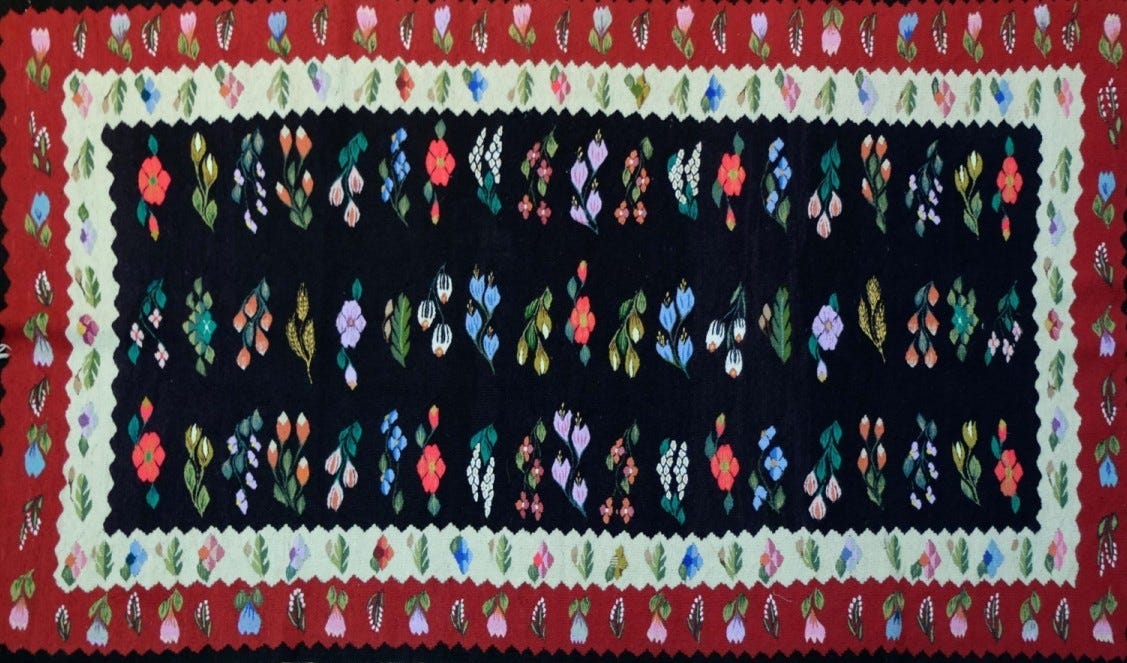
In traditional Romanian villages, scoarța, a handwoven geometric rug, was never meant to be walked on casually. It hung on the wall like a tapestry of collective memory, its intricate knots holding the stories, symbols, and history of the hands that spun it. Each thread carried intention. Each geometric diamond or stylized leaf carried a lineage. When a community relocates across the ocean, that physical fabric stays behind, and the quiet danger of cultural fraying begins.
We know this danger intimately. We have felt it in the silences between generations, in the slow forgetting of words, in the distance that opens when memory has no place to live. What we carried with us across the ocean did not remain whole. It shifted as it passed from one hand to another, thinning in some places, stretching in others. But within that very change, we began to recognize a different kind of continuity, one that depended on use, on touch, on being shaped again with whatever threads were available where we landed.
The community initiatives at ARCS are parts of this weaving, they are the raw thread, the weavers, and the pattern that keep our cultural memory together.
The Raw Thread
You cannot weave without material. You need color, texture, weight, and the foundational fibers that carry memory forward.
For us, the ARCS Community Library serves as that raw thread, a collection of books in Romanian, stories carried across borders, language preserved.
Give a book, get a book. The gesture is simple, but the principle mirrors the roadside wells our ancestors dug in the village, built not for the self, but to ensure that anyone passing through the village can quench their thirst, and leave the water for the next traveler.
These books are the wool we spin into new forms. They are the mother tongue passed from hand to hand, the grammar of belonging, the vocabulary of home. Without the weight of these books, the loom sits empty, and there is nothing to hold the pattern together.
The Weavers
Yet, a rug is never made by a single pair of hands. It requires a collective rhythm, weavers who bring different skills, different tempos, and different visions to the very same wooden frame. This is the purpose of the ARCS Artist Network.
It aims to bring painters, sculptors, photographers, filmmakers, and word makers to the same shared loom. Here, one medium can freely inform another, allowing unexpected patterns to emerge from the exact places where our individual threads overlap.
This is not collaboration for its own sake. It is the recognition that diaspora art, art made in translation, in dual languages, in the space between two worlds, requires more than isolated voices. It requires a chorus. It demands the friction and beauty of many hands working side by side, creating something none of us could have made alone.
We are the weavers. And the loom we share is Washington, a place far from the villages of our grandparents, but close enough to each other to keep weaving.
The Finished Pattern
A tapestry, however, is not fully complete until it is seen. It must be hung on the wall, stepped back from, and allowed to speak directly to those who stand before it.
The ARCS Journal is where that speech begins. It is the surface where our separate, scattered threads can show their true shapes side by side. By gathering the stories, art, and poetry of this cultural moment, it becomes a vibrant record of our presence here, answering our collective motto: Remember Who You Will Become.
A living culture stays fluid as it moves from one set of hands to another, and the journal captures the steady, patient rhythm of that movement. It is the place where the threads are being straightened, held at the proper tension, and prepared. In these pages, we record the unique knots we are tying today, the stable foundations we are stretching across the frame, and the language that defines us in this generation, ensuring the fabric remains unbroken for those who come next.
We weave because the alternative is unraveling.
Culture in diaspora is fragile, yes, but it is also elastic, adaptive, capable of holding new colors and new shapes without losing its essential form. The scoarța our ancestors made maybe did not cross the ocean. But the skill of weaving is within us, we have the memory of patterns, the instinct to gather, to make, to pass something forward that crosses every border.
So we weave. With books and language. With artists and intersections. With words and images that become part of the record.
And row by row, the tapestry grows.
Forward. Alive