

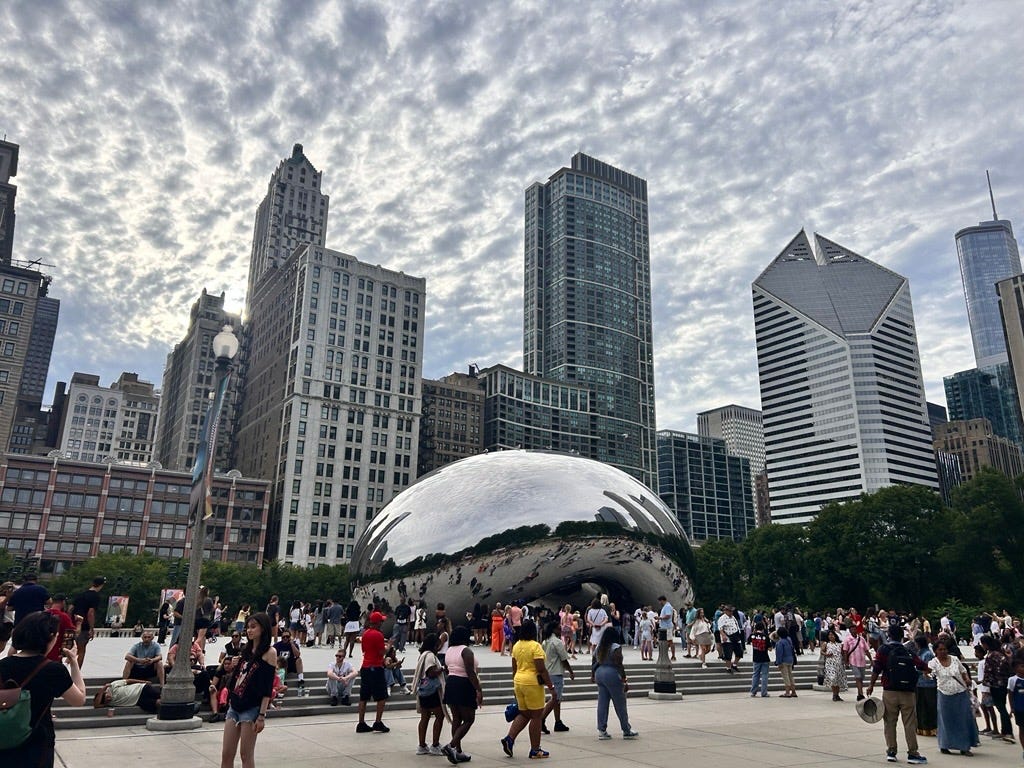
My son and I traveled to Chicago together.
For a few days, we walked the same streets, looked up at the same buildings, ate at the same tables, and collected the same small stories.
Then, at the end of the trip, we went to the airport.
He flew home to Helsinki.
I flew home to Seattle.
There was nothing unusual about it. At least, not for us. Families like ours become fluent in airports. We measure distance in flight times rather than miles. We know how to calculate time differences without looking them up and how to plan visits months ahead. We learn to say, "I'll call you when I land," as naturally as "See you tomorrow."
And yet, somewhere between the airport security line and the two flights carrying us in opposite directions, I found myself thinking about the geography of families.
For a long time, the story of migration seemed to have a fairly simple map. You left one country and made a home in another. The old country remained behind, the new country grew around you, and somewhere between the two, you tried to preserve the language, traditions, and values you hoped your children would carry forward.
But what happens when the family no longer has one place it simply calls home?
Children grow up and build lives in countries their parents eventually leave. Brothers and sisters settle on different continents. Grandparents remain in Romania. Cousins speak to each other from time zones eight or ten hours apart. We gather in Cluj, Helsinki, Seattle, Edinburgh, or sometimes in a city like Chicago that belongs to none of us. Then we return home, except home is no longer the same place for everyone.
The map keeps changing.
Maps tell us where a family is.
They don’t tell us how a family is.
What deserves our attention isn’t where our families live, but what still makes them feel like family.
Part of the answer is easy to see. We share a language, memories and traditions. We make a conscious effort to keep those alive because they help us remember where we come from.
But the things that make us a family are often more subtle.
They live in the way we tease one another, in the silences that don't need filling, in what we consider rude or polite, or how long we linger at a table after the meal is over. They are there in the flavors we search for in unfamiliar cities, in stories that grow richer with every retelling, and in laughter that begins before the punchline because everyone already knows what's coming. Sometimes they might even appear in that stubborn instinct to send someone away with food, regardless of how many restaurants, grocery stores, or airports stand between here and their next meal.
Our children may carry these things into lives very different from ours. They may speak several languages, build families whose maps are even more complicated, and be shaped by every place they call home. Romania will be one of those places, even if it is no longer the only one. They may never know where one influence ends and another begins.
Perhaps they don’t need to.
Perhaps this is another place where culture lives.
Not only in the things we deliberately preserve, but in the rhythms of family, in habits that no one remembers teaching, in ways of welcoming, worrying, laughing, celebrating, and saying goodbye.
Romania is present in those rhythms, even when our homes are scattered across the world.
At the airport in Chicago, my son and I went home in different directions.
But for families scattered across countries, home is no longer where we meet. Home is who recognizes us when we arrive.