

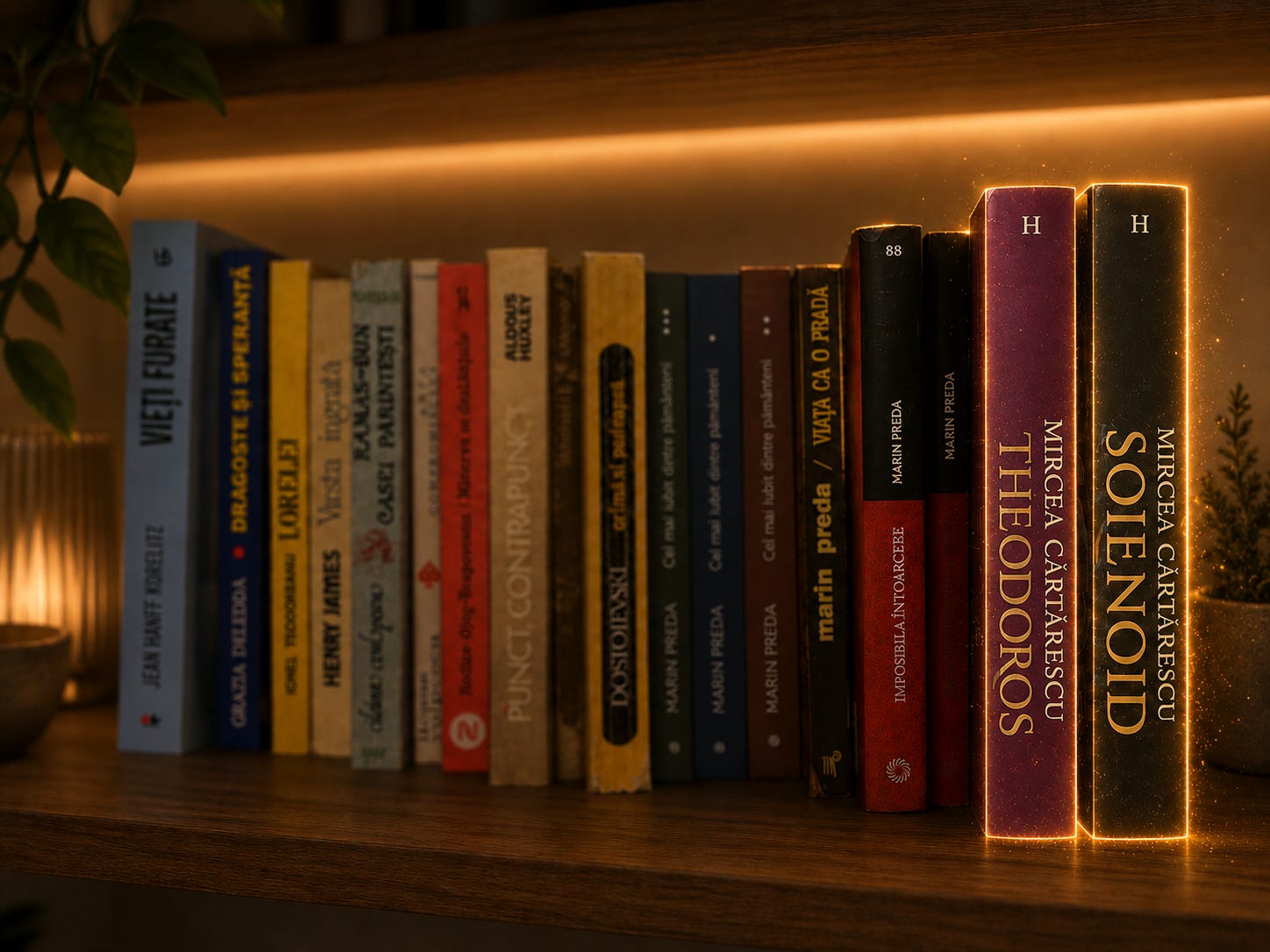
On June 1, Romanian writer Mircea Cărtărescu celebrates his birthday.
Two of his books are sitting on my shelf in Seattle right now: Solenoid and Theodoros. But the book that made me fall in love with his writing was Orbitor.
I first read it while living in Finland, a few years after leaving Romania. Cărtărescu was writing about Bucharest. I grew up in Transylvania. Different city. Different streets. Different childhood.
Yet while reading Orbitor, I often felt as if someone had recovered a parallel version of my own childhood, with its apartment blocks, long summers, children claiming the neighborhood until late in the evening, and adults lingering on street corners for hours or calling to one another from balcony to balcony.
Many writers describe a place.
Cărtărescu often describes what it feels like to remember a place.
I suspect that is part of the reason Orbitor continues to resonate with so many Romanians who left.
When we leave a country, memory tends to preserve its landmarks. The grocery store on the corner. The schoolyard. The old cinema building. The route we walked so many times we no longer noticed it.
What is harder to preserve is atmosphere. The feeling of a summer evening that seemed endless. The conversations drifting through open windows. The comfort of a familiar taste. The strange importance of things that, in retrospect, were entirely ordinary.
Orbitor seems to recover some of that atmosphere.
It reminds readers not simply of where they grew up, but of how it felt to grow up there. It reminds a way of feeling.
I went on to read his later books with equal pleasure, and years later, living in Seattle, I still have Cărtărescu’s novels on my shelves.
But when I think of his writing, I still think first of Orbitor.
Of the rare experience of recognizing yourself inside someone else’s memories.
And of the unexpected comfort of discovering that childhood, at least in literature, can sometimes survive migration better than we do.